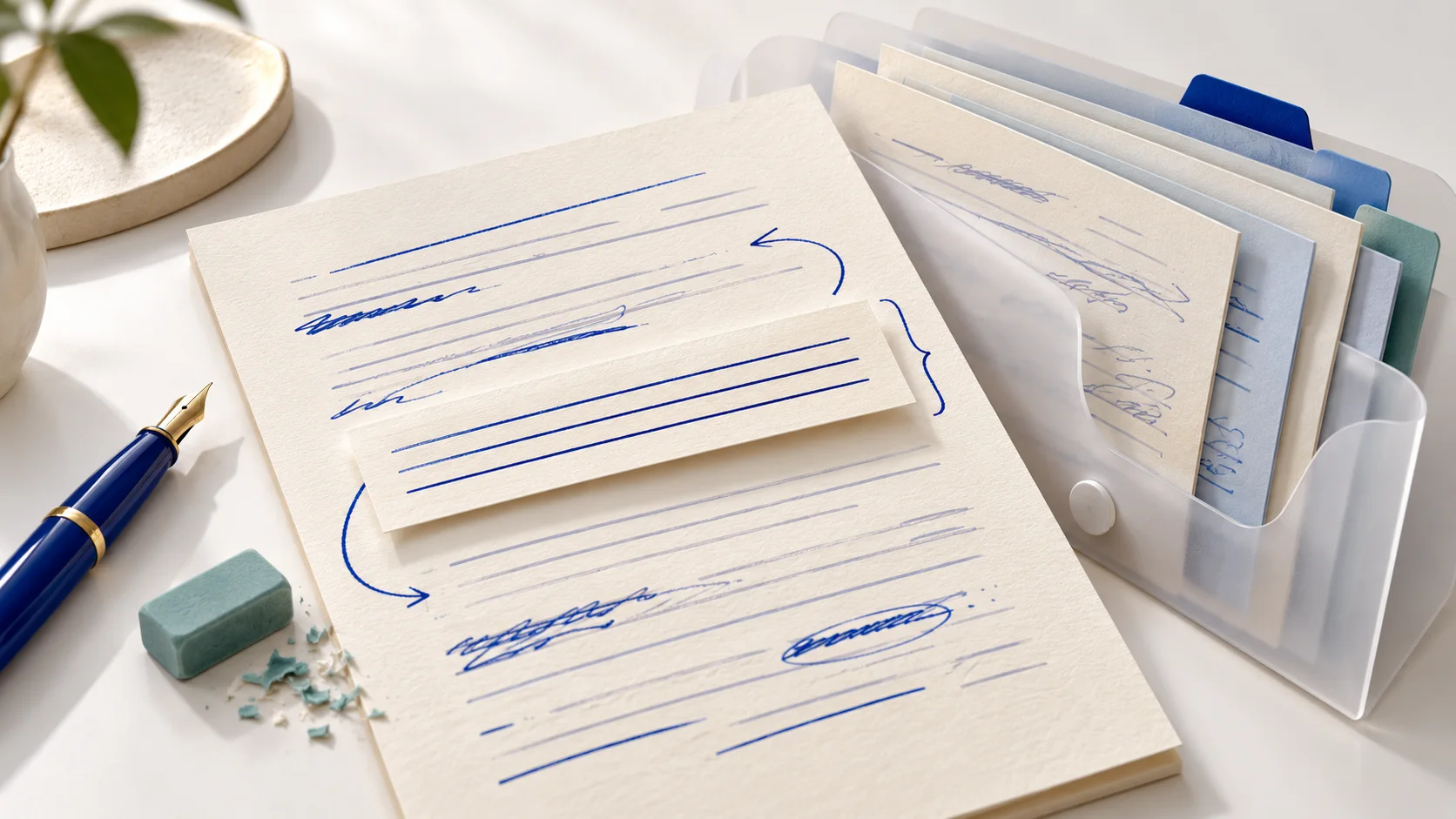

AI newsletters compress complicated developments into a few lines. That pressure can turn a limited result into “the best model,” a favorable price into “the cheapest AI,” or a tool-assisted workflow into “fully autonomous work.” The missing qualification may seem small to the writer while materially changing what the reader understands.
A claim qualification worksheet helps an editor review the complete issue before distribution. It records each strong claim, the evidence supporting it, the limits of that evidence, and the wording approved for publication. This guide focuses on newsletter editing rather than ranking models. Primary documentation was checked on October 6, 2026, and the fictional newsletter examples below are illustrative rather than actual provider claims or measured results.
Review every place a claim can appear
Collect the subject line, preheader, opening summary, section headings, body paragraphs, image captions, link labels, and promotional callouts. A carefully qualified paragraph cannot fully repair an unconditional subject line that readers see first. Likewise, a button labeled “Try the world's smartest AI” creates a factual impression even if it points to an article with detailed limitations.
Copy each material claim into a separate worksheet row. Preserve its location so the reviewer can find the exact wording again. Include explicit superlatives such as “fastest,” “cheapest,” and “safest,” but also examine phrases that imply completeness: “works everywhere,” “never hallucinates,” “replaces all research,” or “requires no human input.” A universal claim can be as broad as a superlative even without the word “best.”
Prioritize claims readers could use to choose a product, allocate a budget, or trust an output. Ordinary enthusiasm about an interesting announcement does not always need to become a comparison, but enthusiasm should not conceal a checkable statement. “An intriguing new approach” and “the most accurate approach available” make different promises.
Build the qualification worksheet
For each row, identify the subject, claimed advantage, metric or behavior, comparison set, operating conditions, source, and date. Add the qualification missing from the draft, the editorial disposition, and the approved replacement text. Keep the original wording in the record so another editor can understand what changed and why.
| Worksheet field | Example question | Publication purpose |
|---|---|---|
| Exact claim and location | What does the subject line actually promise? | Prevents a headline from escaping review |
| Subject and version | Which product or model is being compared? | Avoids transferring evidence between versions |
| Metric and comparison set | Fastest at what, and among which systems? | Defines the scope of an advantage |
| Conditions and date | Under which setup and when? | Keeps a result attached to its limits |
| Primary evidence | Where can the claim be checked directly? | Makes verification traceable |
| Missing qualification | What would a reader otherwise assume? | Guides the revision |
| Approved wording | What can the evidence support? | Produces publishable copy |
Useful dispositions include retain, qualify, attribute, remove, or hold for more evidence. Attribution can be appropriate when describing a company's claim, but it should not be used to smuggle an unsupported comparison into the newsletter's own voice. The approved text still needs to communicate what was and was not established.
Define the comparison behind a superlative
“Fastest” requires a task and a measure. Time until the first visible token, time to finish an answer, total workflow duration, and throughput under concurrent load answer different questions. A result for one measure should not be rewritten as a universal advantage across all of them. Name the measure and the systems actually compared before deciding whether a superlative is justified.
The MLCommons inference benchmark overview illustrates why these details matter. It defines scenarios with particular metrics and benchmarks with datasets and quality targets. It also distinguishes Closed and Open divisions with different model-use rules. Those documented distinctions support keeping the scenario, metric, and division attached to a result; they do not identify the best consumer assistant for every reader.
A newsletter linking such evidence should state the specific comparison supported by the underlying record. If the draft merely says “the fastest AI,” ask which universe of systems was evaluated and whether a quality condition was required. If those details are absent, replace the ranking with a narrower factual description or hold the claim until the source can be checked.
Audit price claims against a defined workload
For “cheapest,” define what is being purchased and how much is used. A subscription fee, an input-token rate, an output-token rate, and the cost of a completed tool-using task are different quantities. A comparison also needs an account tier, billing route, time period, and treatment of included allowances. Without these fields, a low advertised rate can become a misleading total-cost claim.
The current Gemini Developer API pricing page separates model-specific pricing and routes such as standard and batch usage. Its tables distinguish input and output charges, with additional entries where applicable. This provides a primary example of why an editor should retain the relevant table context. The page alone does not establish that one provider is cheapest across every workload and competing service.
Use the worksheet to identify the actual basis of the comparison. If the evidence covers only input pricing for a named model and route, say so. If output length, tool fees, storage, or retries are unknown, leave the complete-task cost unverified. Avoid calling a time-limited introductory price a permanent advantage, and record the date on which the rate was checked.
Qualify claims about autonomy and reliability
“Fully autonomous” needs a defined workflow boundary. An assistant might draft a message, request approval, and then send it through a connected service. It might also require a person to authenticate, supply missing information, select an output, or repair an error. The newsletter should describe the documented steps rather than interpreting any successful action as complete independence from human involvement.
In the worksheet, record the task, required permissions, available tools, approval points, and the evidence that the final action occurred. If the source documents only drafting, do not present delivery as established. If a demonstration includes human confirmation, keep that step in the approved description. A product can be useful while its workflow includes human choices.
Reliability language requires similar discipline. A small set of successful examples does not establish “never makes mistakes.” A result on a specified evaluation does not establish safety or accuracy in every application. When the newsletter uses an absolute phrase, ask what observation could meaningfully support its complete scope. If the source covers only a bounded task or condition, use wording that retains that boundary.
Revise a fictional newsletter issue
Imagine a fictional issue about a product called Cedar Assistant. Its subject line says “The cheapest, fastest AI now works on its own.” The writer's notes contain a provider's input-price table, a demo that drafted a calendar invitation, and a speed comparison involving two configurations. None of these hypothetical notes establishes the full subject-line claim.
The worksheet creates three rows. The price row needs a defined workload and comparison set. The speed row needs the measured interval, tested configurations, and quality criterion. The autonomy row needs evidence about creating and sending the invitation, including any approval step. Until those questions are answered, the newsletter should remove the combined superlative and describe the documented feature without a ranking.
Suppose further primary documentation establishes that Cedar drafts invitations and asks the user to confirm before sending. The approved description can say that it supports invitation drafting with a confirmation step before delivery. That sentence communicates the verified behavior without declaring the entire workflow autonomous. It also gives readers information they can use to understand the product.
If the two-configuration speed comparison is adequately documented, a bounded description can identify the exact task and configurations involved. Do not invent a measured number during editing. The approved wording must come from the checked result, and the worksheet should retain the source and date so that a later editor can revisit it when the product changes.
Keep qualification and attribution visible
Place the key limitation in the sentence that makes the claim. A qualification several paragraphs later may be missed when a reader scans the issue or sees a shortened preview. Use specific nouns and verbs: the named model achieved a recorded result on a named task under identified conditions. Such wording often makes a superlative unnecessary while preserving the meaningful finding.
When a company makes a broader claim than the newsletter can independently verify, attribute it clearly and explain the evidence boundary. “The company describes the system as its fastest model” concerns the company's characterization and internal comparison. It should not be rewritten as “the fastest model available” without a separately supported market-wide comparison.
Recheck the subject line after the body is approved. It should convey the same scope as the article summary. Review image captions and link labels too, especially if they were written by another contributor. A qualified body paired with an unconditional promotional label can recreate the unsupported claim you just removed.
Preserve decisions and revisit material changes
Save the completed worksheet with the issue version, checked source URLs, review date, reviewer, and approved text. Add a follow-up question for any held claim. A future release, revised benchmark record, expired offer, or changed operating requirement can alter whether old wording remains supported. The worksheet makes those dependencies visible rather than leaving them in one writer's memory.
If an issue has already been distributed with a material unsupported claim, record the correction and explain the change in the channel appropriate to your publication. Update the accessible archive where possible while preserving a correction note. The exact process depends on the newsroom's policy, but silently deleting the review history makes future verification harder.
For comparative numbers, use the benchmark evaluation-conditions guide alongside this worksheet. For the timing of a discounted offer, use the promotion expiry audit. For claims based on a video, consult the demo reproduction report. These related checks supply evidence; the newsletter worksheet decides which wording that evidence supports in each visible part of the issue.
Frequently asked questions
Are superlatives always inappropriate in an AI newsletter?
No. A properly supported comparison can justify a bounded superlative. Identify the task, metric, systems compared, conditions, and date, and keep those qualifications close to the claim. Avoid expanding a limited result into a universal ranking that the evidence did not evaluate.
Is it enough to say that the company claims its model is best?
Attribution tells readers who made the claim, but does not verify its substance. Preserve the company's actual comparison scope and distinguish it from the newsletter's own conclusion. If the evidence is incomplete, explain the limit or choose a concrete description without the unsupported ranking.
How should a newsletter compare AI prices?
Use a defined workload, billing route, account tier, usage amount, and check date. Include the relevant charge components and allowances, or identify which parts remain unknown. A single low input rate is insufficient to establish the lowest cost of a complete task across all competing products.
Should qualifications appear in the subject line?
The subject line should not imply a broader claim than the issue supports. When a detailed qualification will not fit, use a concrete feature or development as the subject instead of an unconditional ranking. Review the preheader and visible link labels for the same scope.
Does an unsupported claim mean the product is poor?
No. It means the checked evidence does not establish that particular wording. The editorial response is to narrow, attribute, remove, or hold the claim as appropriate. A product's actual usefulness can still be described through documented features and carefully scoped observations.