

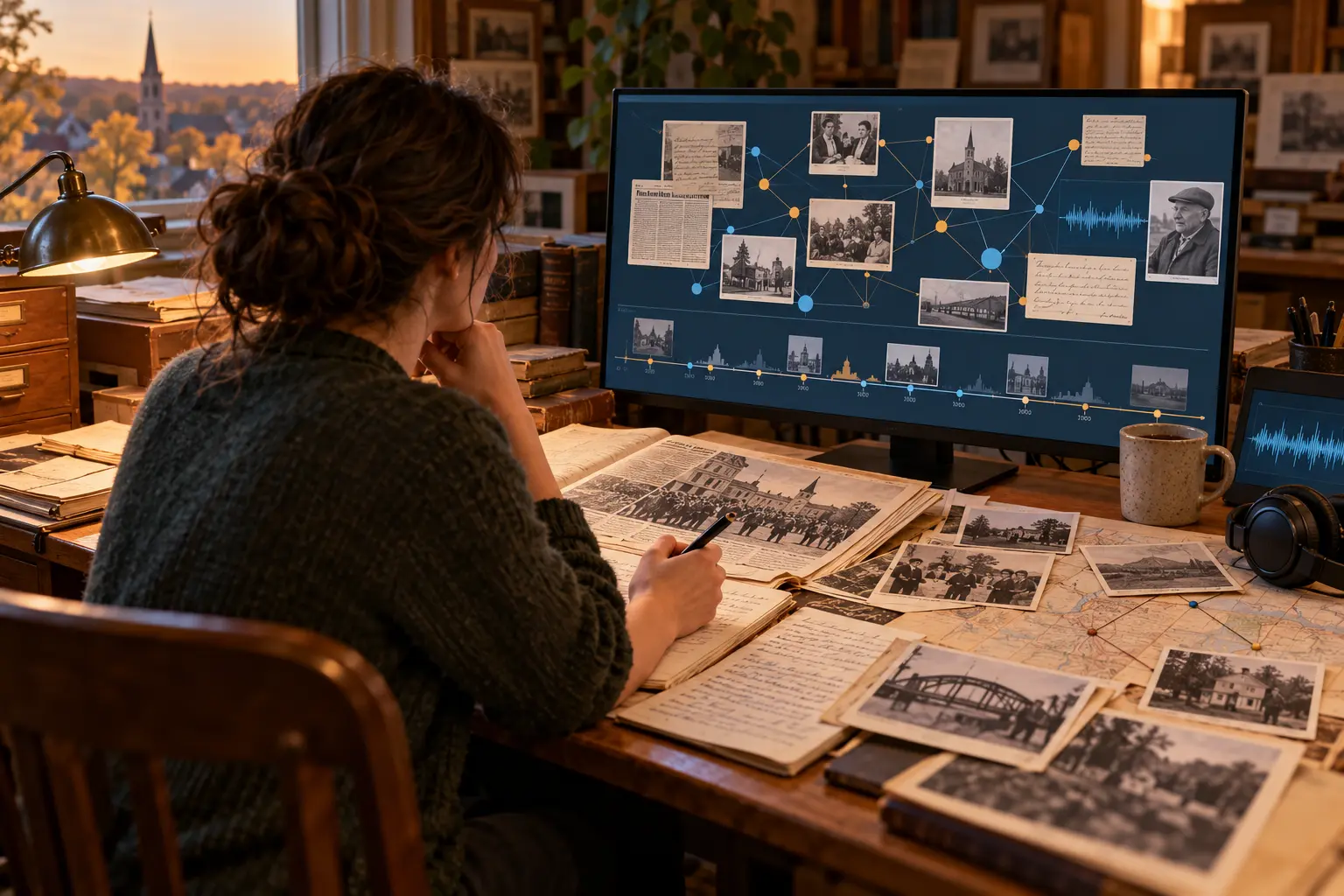
NotebookLM can make a difficult source set navigable, but it does not remove the need for provenance, citation review, and human judgment. This guide turns “Local-history source map” into a repeatable research artifact rather than a one-click summary. Product behavior and help documentation were checked on October 8, 2026. Google says NotebookLM answers from the sources in a notebook and provides citations that can be opened in context. Source limits and supported formats can change, so confirm the current NotebookLM source documentation before starting.
Begin with a bounded historical question
Local history becomes manageable when the notebook is organized around a question rather than a place name alone. Define the event, time window, geographic boundary, and people whose experiences matter. “How did the 1968 factory closure change travel, family work, and neighborhood institutions within five years?” is more useful than “history of the town.” The bounded question determines which newspaper issues, interviews, minutes, maps, and photographs belong in the project. It also exposes absence: a surviving paper may describe officials repeatedly while barely recording migrant workers, women, tenants, or displaced families. Write the scope as a one-paragraph research charter and upload it as the first source so every later query can be tested against the same limits.
Create a source register before asking for a narrative. Give every item a stable code, date, creator, collection, and source type. Record whether an oral account is a full transcript, an edited excerpt, or a summary; whether a newspaper page is an original scan or an OCR transcription; and whether a photograph has a contemporaneous caption. This register is the backbone of the local-history source map. It makes it possible to separate what the source says from what the researcher inferred, and it prevents a polished NotebookLM answer from hiding gaps in the archive.
Prepare newspapers and oral accounts for reliable retrieval
Newspaper OCR is often noisy around columns, hyphenation, advertisements, and damaged pages. Correct names, dates, and headings that are central to the question, but retain page images or archive links so a researcher can inspect the original. Divide large runs into files with clear date ranges instead of uploading an undifferentiated archive. For oral histories, use speaker labels, timestamps, interview date, interviewer name, and notes about any redaction or translation. A transcript should preserve uncertainty and pauses when they affect meaning; smoothing every sentence can convert memory into apparent certainty.
Treat newspapers and interviews as different evidence forms. A newspaper report may offer contemporaneous chronology but reflect editorial selection, political language, deadlines, and access to officials. An oral account may recover experience excluded from print, yet memory can compress dates or combine events. Do not ask NotebookLM to decide which type is “more accurate” in the abstract. Ask what each source can establish, what it cannot establish, and which claims require corroboration. The National Archives emphasizes examining point of view, bias, contradictions, and reliability in primary sources; those questions should become explicit fields in the source map.
Build a source map instead of a single summary
Use a table with rows for claims or events and columns for date, place, actor, newspaper evidence, oral evidence, other records, agreement, tension, and unresolved question. Ask NotebookLM for one event at a time and require citations for every filled cell. When a citation points to a long interview, open it and capture the relevant timestamp in your own table. When it points to OCR, compare the excerpt with the page image. The map is not merely an index: it shows where independent sources converge and where one source is repeating another.
Add a relationship layer for people, institutions, and locations. A newspaper editor may also sit on the chamber of commerce; an interviewee may be recalling a parent’s account; a city report may quote the same press release reproduced by several papers. These links change the apparent weight of evidence. NotebookLM can help identify recurring names and organizations, but the researcher must verify identity, especially when initials, married names, nicknames, or transcription errors vary across sources.
Compare accounts without forcing agreement
Run paired questions such as: “What sequence does the newspaper establish?” and “How do interviewees describe the same sequence?” Then ask for a discrepancy ledger containing the exact claim, each cited passage, the type of conflict, and plausible explanations that remain hypotheses. Distinguish date disagreement from causal disagreement, vocabulary differences, and differences in social position. A factory manager and a laid-off worker can describe the same meeting truthfully while emphasizing different consequences.
Preserve minority accounts even when they appear once. Frequency inside a small source set is not proof of truth or importance. Instead, label support as single-source, multiple dependent sources, or independently corroborated. A useful NotebookLM prompt asks for counterevidence before synthesis: “Find passages that complicate this interpretation and identify whose perspective is missing.” That instruction reduces the temptation to turn a contested past into a frictionless story.
Construct a layered chronology
Create three parallel timelines: documented events, published representations, and remembered experiences. The first tracks dated actions such as votes, closures, protests, and construction. The second tracks when newspapers framed those events and which terms changed. The third records when interviewees say consequences became visible in daily life. Misalignment is analytically valuable. Public policy can be announced on one date, reported optimistically the next day, and remembered through effects that emerged months later.
Every timeline entry should carry a confidence note and a citation. Use exact dates only when the source supports them; otherwise use month, season, or approximate range. Avoid converting “that winter” into a precise day. Ask NotebookLM to list temporal phrases that do not resolve cleanly, then verify them against calendars, weather records, meeting minutes, or additional issues. The objective is an auditable chronology, not artificial precision.
Turn the map into an evidence-led narrative
Draft from the source map, not from the notebook chat transcript. Each paragraph should answer a small question, cite the relevant evidence, and state uncertainty where necessary. Separate contemporary descriptions from retrospective interpretation. A strong local-history narrative shows how institutions presented an event, how residents experienced it, and how later memory reorganized its meaning. It does not use one vivid quotation as a substitute for representativeness.
Before publication, perform a name, date, quotation, and context audit. Reopen every citation, compare direct quotations with originals, and confirm permissions or access conditions for oral-history material and images. Protect sensitive personal information and follow the archive’s terms. The final source map can accompany the article as a research appendix, allowing readers to see which claims are well corroborated and which remain open.
NotebookLM workflow
- Write the research charter. Define the decision or question, scope, exclusions, source cutoff, roles, and required deliverable.
- Create a source register. Assign stable IDs, preserve dates and versions, and record provenance outside the chat interface.
- Upload in coherent groups. Keep source types and versions distinguishable. Use NotebookLM’s source selector to limit a question to the relevant evidence.
- Ask atomic questions. Request one field, claim, comparison, or contradiction at a time and require citations.
- Open every consequential citation. Google’s chat and citation documentation explains that a citation can be opened to view the supporting context. Check that the passage supports the wording and that nearby qualifications were retained.
- Record the result in the deliverable. Move verified evidence into a maintained map or matrix with a status, reviewer, and unresolved-question field.
- Seek disconfirming evidence. Prompt for exceptions, contrary passages, missing groups, alternative explanations, and terms used inconsistently.
- Review with domain experts. NotebookLM assists retrieval; accountable people make methodological, legal, ethical, and publication decisions.
For setup fundamentals, see our guide to using NotebookLM with research sources. A useful rhythm is source preparation, narrow retrieval, citation inspection, structured recording, adversarial review, and revision. Save prompt wording and the date of the source set when reproducibility matters. Never treat the absence of a retrieved passage as proof that the source contains no relevant evidence; improve naming, scope, OCR, or segmentation and check manually.
Quality-control checklist
- Every major claim has a source ID and a citation inspected in context.
- Direct quotation, paraphrase, inference, and recommendation are visibly distinct.
- Dates, names, thresholds, and definitions are checked against the original.
- Versions are explicit; superseded documents remain traceable.
- Contradictions and minority evidence are retained rather than averaged away.
- Missing evidence is labeled, not filled with plausible language.
- Sensitive information, access rights, copyright, and consent are reviewed.
- The final local-history source map has an owner, review date, and unresolved-issues section.
Run a final “citation inversion” audit: begin with each conclusion and travel backward through the matrix to the source passage. Then travel forward from each high-priority source to see whether its material claims appear in the synthesis. This two-way test catches unsupported conclusions as well as important evidence that was dropped. Treat generated wording as a draft until that audit is complete.
Frequently asked questions
Can NotebookLM read scanned newspapers?
It works best with machine-readable text. Use high-quality OCR, keep the original page reference, and verify quotations against the scan.
Should oral histories be treated as factual transcripts?
Treat them as evidence of experience and memory with context, not as automatically precise chronology. Record timestamps, interview conditions, and uncertainty.
How many sources are enough?
Coverage matters more than a magic number. Seek independent source types, affected communities, and records capable of challenging the initial interpretation.
What belongs in a local-history source map?
Stable source IDs, provenance, dates, people, claims, citations, agreements, tensions, missing voices, and unresolved questions.
Can NotebookLM write the final history?
Use it to retrieve and compare evidence, then write and fact-check the narrative yourself. Every consequential claim should be verified in the source.
Primary sources and further reading
- Google NotebookLM Help: Add or discover new sources
- Google NotebookLM Help: Chat with your sources and use citations
- U.S. National Archives: History in the Raw
Illustrative examples in this guide are hypothetical and are included to demonstrate the workflow. They are not findings about a real project, person, debate, study, or infrastructure proposal.