Updated October 5, 2026. A practical guide to Hermes, with examples, FAQs and official resources. Check the linked product documentation for current access, setup and limitations.
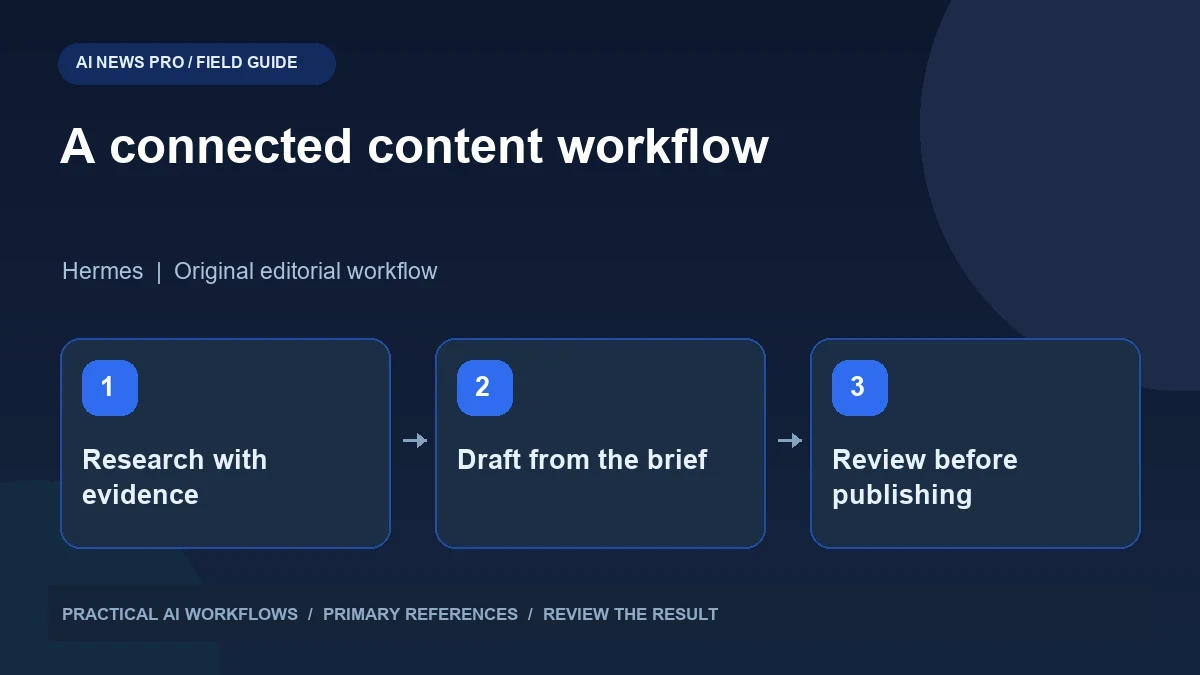
Illustration: an original editorial workflow graphic created for this article.
Design a connected research and publishing workflow
Hermes, Claude, and Codex can participate in a connected workflow for research, content ideas, drafting, review, and website publishing. The useful system is defined by its handoffs and configuration rather than by the names assigned to its workers. A custom orchestration setup is not automatically included in every agent installation. Check the actual repository, tools, and provider connections before expecting a particular workflow to run. This guide explains how to divide the process into reviewable deliverables, preserve source evidence, and assign clear responsibility for the final result. Start with one article and verify each transition before expanding into a larger content pipeline.
Hermes itself is an agent framework from Nous Research. Its official repository documents capabilities including reusable skills, memory, scheduling, and model selection. Connecting a framework with other tools still requires an actual configuration, suitable permissions, and reliable handoffs.
The practical opportunity is to reduce repeated copying between research, drafting, and implementation. This guide proposes an independent architecture for a small content team: one shared brief, explicit task responsibilities, and a review stage that checks the result before it reaches a public website.
Make the shared brief the center of the system
A connected workflow should move a structured brief rather than an expanding conversation transcript. Include the topic, audience, publication destination, approved sources, unanswered questions, and the definition of done. Give the brief a stable identifier so each task can refer to the same piece of work.
For an AI news article, the brief might record the release date separately from the date of a later tutorial. It should list which feature claims are confirmed by official documentation and which remain reported. The drafting task should not have to rediscover these distinctions. The implementation task should receive the approved text and asset paths, not an instruction to improvise missing sections. This design reduces inconsistent interpretations and makes it possible to see whether a mistake originated in research, writing, or installation.
Continue the workflow: How to Build a Multi-Agent System with LangGraph and AutoGen in 2026.
Assign tools according to the work
Use a research-capable task to gather evidence, a writing task to create the article, and a coding task to handle website-specific changes. These responsibilities can be handled by different tools or by the same tool in separate stages. A larger number of agents is not inherently a better system.
Choose tools based on the data they can access and the work they can verify. A researcher needs authoritative sources and publication metadata. A writer needs the verified brief and editorial requirements. A coding task needs the repository, database schema, and local validation process. Make outputs explicit: a source table, a reviewed HTML article, and an installation report are different deliverables. Avoid handing a vague instruction from one stage to the next and assuming that every task knows what the previous task actually completed.
Design a useful handoff contract
Each stage should return a result with status, artifact location, evidence, and unresolved questions. For example, research can return ready for drafting only when required dates and resource URLs are known. Drafting can return ready for review only when the article has the required sections and no unsupported claims. Installation can return complete only after the page and image load.
Include a failure state. If a video description is unavailable, the researcher should report that limitation instead of inventing its contents. If a database category is missing, the importer should stop with a clear message instead of silently choosing an unrelated category. Store the handoff record with the article. This makes retries safer because the next run can determine whether it is repeating an unfinished task or duplicating work that already succeeded.
Pilot one article through the complete loop
Choose a narrow topic with an official source and a clear reader question. Run it through research, drafting, image preparation, editorial review, and local installation. Measure the full process, including corrections. A fast draft is not the final outcome if someone still spends an hour repairing links or correcting feature availability.
Inspect the final page in the environment where readers will use it. Check the heading hierarchy, table-of-contents anchors, internal links, image loading, and resource-link styling. Confirm that a repeat installation does not create a duplicate article. Ask a teammate to follow the source trail and identify the article's main takeaway. Record each handoff that required clarification. Those observations tell you which contract or instruction needs improvement before the workflow is used for a larger batch.
Continue the workflow: Hermes Agent and Search Console: Find SEO Opportunities Without Inventing Results.
A worked example to try
Consider a fictional content team preparing a guide to choosing a research assistant. Assign research to produce a source table, drafting to create an outline and article, and review to check every product claim. Store each output in a clearly named location. The drafting stage should not begin with a vague instruction to find something interesting; it should receive the approved research brief.
If a source changes during the process, update the research table and tell the downstream stage which claim changed. Do not allow one worker to silently publish a new conclusion while another still uses the old reference. End with a final reviewer who checks the combined article and links. The example illustrates why explicit handoffs are as important as the choice of agents or models in a connected workflow.
Expand only after the responsibilities are clear
Once the pilot works, add a small batch and observe where work queues up. Research may be the bottleneck for fast-changing tools, while image review may be the bottleneck for design-heavy topics. Improve the stage that slows the real process rather than adding agents indiscriminately.
Keep publication separate from content generation so a draft cannot become public merely because an upstream stage finished. Use your site's existing review and deployment controls. Define who owns corrections after publication and how source changes are tracked. A connected system should leave a useful trail: which topic was chosen, which evidence supported it, which version was approved, and which page was installed. That trail is what turns a collection of impressive demonstrations into a workflow a small team can maintain and trust.
Frequently asked questions
Are the named agents in the video standard Hermes features?
Do not assume so. Named workers belong to a particular configured system. Check the actual repository and configuration before expecting those named workflows in your installation.
Do I need several models for this workflow?
No. Separate responsibilities and deliverables first. You can use one tool for several stages when it has the necessary capabilities and the handoffs remain clear.
What should pass from research to writing?
Pass a structured brief with verified facts, dates, sources, audience, and unresolved questions. Avoid relying on an informal transcript that hides important distinctions.
What makes retries reliable?
Store status and artifact identifiers, and make installation duplicate-safe. A retry should determine what already succeeded before repeating a write or publishing action.
What is the best first pilot?
Use one narrow article with official documentation. Complete the entire path to a working local page, then inspect correction time and handoff failures.
When should I add more automation?
Expand after the pilot works repeatedly and you know the bottleneck. Add automation to a specific stage rather than increasing the number of agents without a clear need.
Resources and references
Use these links to verify capabilities, access and setup. Product documentation can change after this editorial check.