
Editorial check: October 5, 2026. Official release: September 23, 2026.
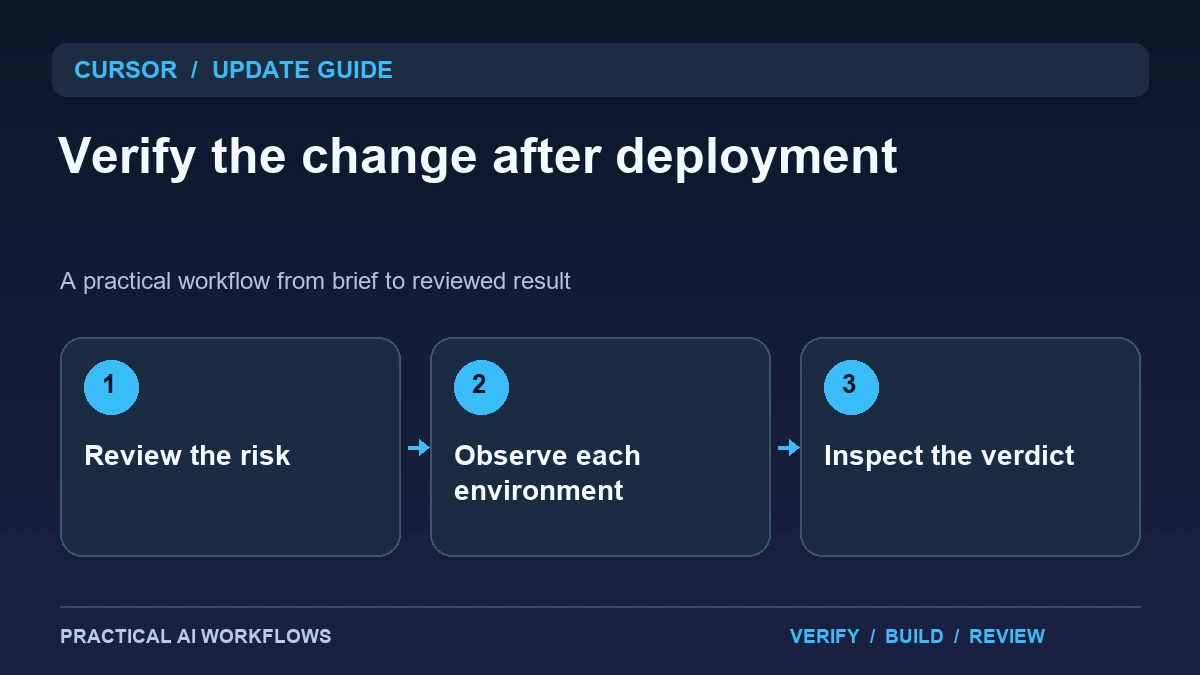
Illustration: an original editorial workflow graphic created for this article.
What changed in Cursor
Cursor's September 23 release notes introduce Rollouts and Security Review for Teams and Enterprise. Rollouts evaluates deployed changes by environment, while Security Review examines pull requests for exploitable problems. These are distinct stages of release verification. The announcement describes reviewable findings and monitoring plans; it does not establish that every deployed change can be judged conclusively or that an automated review proves an application secure.
The practical value is connecting a code change to evidence about its behavior. A passing test suite tells you something about the tested inputs, while deployment monitoring tells you what actually happened in a particular environment. Start with a small service whose telemetry you understand. Choose a change with a measurable intended effect, document the current baseline, and decide who will review a warning or inconclusive result. This guide explains how to make the new controls part of a coherent release process.
Define the intended effect before merging
Write a release brief with the trigger, expected behavior, affected component, and plausible failure. For a search endpoint, a change might reduce repeated database requests without changing which results appear. The brief should distinguish that intended effect from general health signals such as error rate and latency. A deployment can remain healthy while failing to achieve its purpose.
List the environments where the change will run and the signals available in each. Staging may have synthetic traffic, while production has actual visitors and different load. Record the expected observation window and a reason to stop or escalate. Avoid choosing an arbitrary green threshold without understanding normal variation. If the service has little traffic, an inconclusive verdict may be more honest than a claim of success. The brief helps a reviewer interpret results and provides concrete context for the monitoring plan.
Continue the workflow: Claude Code: A Careful Workflow for Existing Projects.
Review the monitoring plan as an engineering artifact
Read the proposed plan before depending on it. Check whether the identified risks match the changed code and whether the selected signals can actually reveal those risks. If a migration changes background processing, a homepage uptime check will not be sufficient. Add the queue behavior, failed jobs, or data consistency observations relevant to the change.
Keep the plan short enough that another engineer can review it. Explain each signal's purpose and any instrumentation gap. Confirm that the deployment event is associated with the right commit and environment; otherwise the evidence may describe a different version. Treat a plan revision like any other engineering decision and retain it with the pull request. A useful plan tells the team what it will learn after deployment, what it cannot learn, and which response follows an observed regression.
Use security findings to produce specific checks
A security finding should lead to a focused investigation. Read the described input path, relevant code, and proposed repair. Reproduce the issue with fictional data in a controlled environment. For an authorization concern, test a logged-out request and a request from a user with the wrong role. Compare the response body as well as the visible interface.
Inspect the repair rather than accepting it because a bot supplied it. Confirm that the server enforces the intended boundary and that ordinary authorized behavior still works. If a finding is dismissed, record a clear reason supported by the code or test evidence. Keep style feedback separate from exploitable behavior so the important issue is easy to see. Automated review becomes more useful when each result is converted into a check a person can understand and repeat.
A worked example: repairing an article search endpoint
Imagine a fictional blog whose search endpoint performs duplicate reads. The change consolidates those reads, and the release brief specifies that search results and category filtering must remain identical. Before deployment, save representative queries and the expected results. Add a test for an empty query and one for a selected category.
In staging, confirm the new version handles those examples and reduces the relevant database activity. After production deployment, inspect error and latency signals alongside the search behavior. If activity drops because the endpoint stopped serving requests, that is a regression rather than an efficiency improvement. A warning should identify the changed version and the evidence behind it. This example illustrates why intended effect, general health, and correctness need separate observations instead of one broad success badge.
Continue the workflow: Google AI Studio Security Review: What Is Reported and How to Audit Your App.
Investigate a green result that hides the wrong outcome
Consider a release that removes a slow database query by returning cached results. The latency chart improves immediately, but readers begin seeing articles from a category they did not select. A broad availability check will probably remain green. Investigate the actual request, selected category, cache key, and result set before calling the optimization successful. Save one failing request with fictional identifiers so another engineer can reproduce the mismatch. Then compare it with the corresponding request before the change. This turns a vague complaint into a concrete behavioral difference.
Keep a small release notebook with three columns: expected effect, evidence collected, and unresolved question. Write down the time and environment for each observation. When evidence conflicts, explain the conflict rather than averaging it into a reassuring conclusion. A useful next action might be adding a missing correctness check, narrowing deployment exposure, or preparing a repair. Assign someone to that action and record how its completion will be verified. The notebook also helps a team distinguish a monitoring gap from a genuine application failure. Over several releases, these short records reveal which signals consistently catch problems and which dashboards merely look informative.
Close the release with evidence and a recovery decision
At the end of the observation window, record the environment, deployed version, checks, verdict, and outstanding uncertainty. Decide whether the result is sufficient to continue the rollout. If a proposed revert or repair is needed, review its consequences, including schema or data changes that cannot be reversed by reverting code alone.
Maintain a simple recovery procedure that the team has tested. Know who can pause a deployment and how to verify the recovered version. After the incident or release, compare the original plan with what actually revealed the problem. Improve the next plan using that evidence. The useful outcome from release bots is a clearer connection between changes, observations, and responsibility. They can help gather and organize evidence, while engineers still decide whether the product behaves correctly and what action the findings justify.
Frequently asked questions
When was this update announced?
Cursor's official release notes date Rollouts and Security Review to September 23, 2026. This guide was checked on October 5 and does not present that older date as today's launch.
Do the two bots serve the same purpose?
No. Deployment monitoring and pull-request security review address different questions. Use both results as evidence within your existing engineering review process.
Does a healthy deployment prove the change worked?
Not necessarily. Check the intended effect separately from general error and latency signals. A change can remain available while producing the wrong behavior.
What should an inconclusive result mean?
Identify the missing evidence, traffic, or instrumentation. An honest inconclusive result is useful when the available signals cannot support a dependable judgment.
Should every proposed repair be accepted?
Inspect the affected code and reproduce the issue where possible. Verify the repair and normal behavior before treating the finding as resolved.
What is a good first pilot?
Choose one small service with understandable telemetry, a measurable change, and a clear recovery procedure. Expand after the monitoring results prove useful.
Resources and references
Official references checked on October 5, 2026. Consult the current documentation for access, setup and limitations.