Updated October 5, 2026. A practical guide to Hermes, with examples, FAQs and official resources. Check the linked product documentation for current access, setup and limitations.
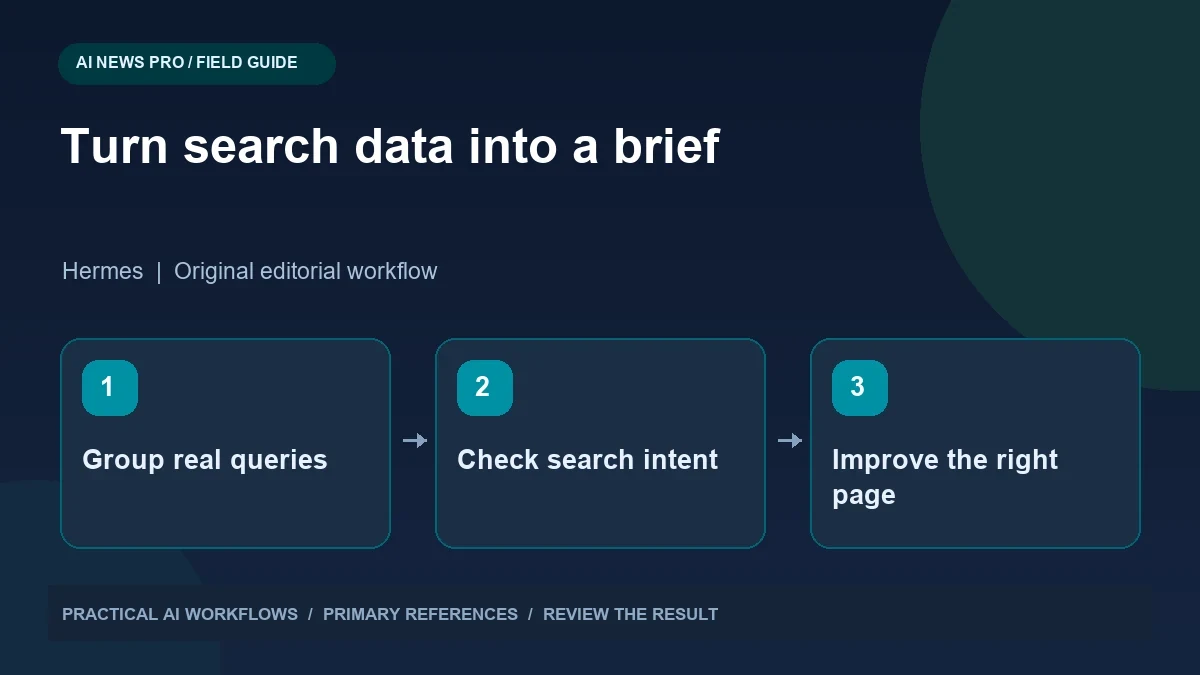
Illustration: an original editorial workflow graphic created for this article.
Find relevant opportunities in Search Console
Search Console can reveal queries that receive impressions but few clicks, giving an editorial team a useful starting point for content review. Hermes Agent can assist with organizing an authorized export, grouping relevant questions, and preparing briefs for selected opportunities. The important step is deciding whether the query represents a need your website can answer well. Traffic figures from another site's case study are not a forecast for your own site. This guide focuses on evidence, audience relevance, and measurable edits instead of ranking promises. Keep a dated record of the source data, chosen opportunity, published change, and later observations.
The useful starting point is your own Search Console data. Impressions show that a page appeared for a query, but they do not by themselves prove that a new article is needed. The query may have the wrong intent, weak positioning, an unsuitable title, or insufficient relevance.
This guide offers an independent process for deciding which opportunities deserve work. An agent can help organize and compare the data, while the editorial decision depends on whether you can provide a useful answer with evidence your audience needs.
Export data with enough context
Choose a date range long enough to reduce the influence of a single unusual day. Export queries with clicks, impressions, click-through rate, and average position, then inspect the pages associated with promising queries. Keep country and device filters consistent when comparing periods. Document the range and filters in the brief.
A query with many impressions and no clicks can mean very different things depending on average position and the page shown. If the page appears far below the first results, a title rewrite may not solve the underlying problem. If several queries refer to the same question, group them before deciding how many pages to create. Ask the agent to preserve the raw values and show its grouping rationale. This makes its suggestions inspectable and avoids turning a noisy export into dozens of unnecessary articles.
Continue the workflow: Claude for SEO Content: Research, Draft, and Improve.
Classify intent before choosing a page
Read the query as a person with a problem. Are they seeking a definition, installation steps, a comparison, a price, or troubleshooting? Look at the existing page and ask whether it answers that question. A general introduction may receive impressions for a specific setup issue without actually providing the required instructions.
Create a small opportunity table with query group, current page, intended reader, missing answer, and proposed action. Actions might include improving an existing section, adding an FAQ, updating a title, consolidating competing pages, or creating a new article. Do not make new article the default. A strong decision explains why the chosen action serves the reader better than alternatives. This reduces overlap and gives writers a concrete brief instead of an instruction to mention a keyword several times.
Use firsthand material as the article's backbone
A useful new page should contain something more specific than a rewritten search result. Supply a real example, a tested workflow, an original checklist, or a comparison based on stated criteria. If you have not tested a tool, say that the guide explains documented behavior rather than claiming firsthand results.
For a setup article, record the prerequisites, steps, expected outcome, and common failure conditions. For a comparison, use the same task and review criteria for each option. For a case study, preserve the dates, baseline, changes, and limitations. Ask the agent to flag claims that have no supporting material. The article should make it easier for a reader to complete the task, not merely add another page to the site's inventory. That standard is useful regardless of how the initial keyword opportunity was discovered.
Treat outreach as a separate editorial decision
The video describes automated backlink outreach, but your data-to-content workflow does not require sending messages automatically. First decide whether the article contains a resource another site would reasonably want to reference. A specific original study or practical tool is a stronger reason to contact someone than the fact that you published a keyword page.
Prepare a relevant outreach draft and review its recipient, purpose, and claims before sending. Avoid fabricated compliments, invented relationships, or promises about rankings. Keep a record of where the resource was shared so follow-ups are appropriate. Content quality and outreach quality should be evaluated separately. A page can serve readers well without a large outreach campaign, and a high volume of messages does not establish that the content deserves links. Begin with relevance and a credible reason for the conversation.
Continue the workflow: Launching a New Website with Claude: A Practical SEO Workflow Without Ranking Promises.
A worked example to try
Suppose a tutorial receives impressions for 'export research citations' but its current text only explains how to create a notebook. Inspect the query context and the product documentation before deciding whether to expand the tutorial. If citation export is a relevant supported task, add a clearly scoped section with steps and limitations. If the requested export does not exist, explain the actual options rather than inventing a button.
Record the edit date and compare a later period with a sensible earlier period. Also note other changes, such as a new title or a product release. Do not attribute every increase to the agent. The opportunity queue should help you prioritize useful corrections and additions; the evidence still needs interpretation, and search performance can change for reasons outside the article.
Measure the result without overclaiming causality
After publication or revision, compare the same query groups and pages over a sensible period. Track clicks, impressions, position, and the action readers take on the page. Record other changes that could influence the result, such as a site redesign, seasonal demand, or an external mention.
Do not declare a strategy proven because one query improved immediately. Search performance is variable, and a before-and-after comparison does not isolate every cause. Look for repeated patterns across the selected pages. Keep successful briefs as examples and revise the process when new pages attract impressions without satisfying their intended readers. An effective agent-assisted SEO loop improves the decisions you make from real evidence. It does not promise that every generated article will rank quickly or reproduce another site's traffic numbers.
Frequently asked questions
Do impressions without clicks always require a new article?
No. Inspect the page, search intent, position, and query group first. Improving an existing section or title may be more appropriate than creating another page.
Can I expect the video's traffic results?
No. The reported figures describe an individual site's case study. Your niche, site history, content, demand, and competition can produce very different outcomes.
What should an agent do with the export?
Group related queries, preserve raw metrics, explain its classifications, and propose actions with reasons. It should not hide the underlying data or invent missing values.
How do I avoid overlapping pages?
Map query groups to existing pages before drafting. Create a new page only when it serves a distinct reader question that the current page does not answer well.
Should backlink outreach run automatically?
Treat it as a separate decision. Review recipient relevance, the actual resource, and the message before sending rather than making outreach an automatic consequence of drafting.
What should I measure after publishing?
Compare consistent query groups and date filters, then inspect clicks and useful reader actions. Record other site changes and avoid attributing every improvement to one intervention.
Resources and references
Use these links to verify capabilities, access and setup. Product documentation can change after this editorial check.