
Updated October 5, 2026. A practical guide to Claude SEO, with examples, FAQs and official resources. Check the linked product documentation for current access, setup and limitations.
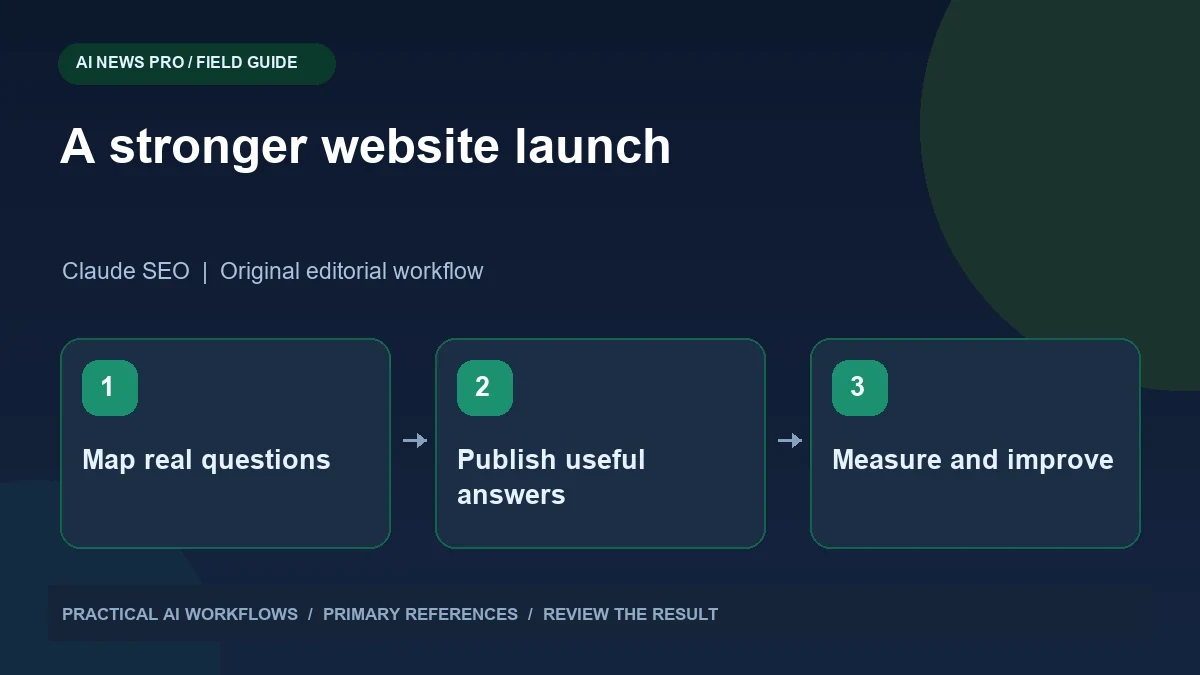
Illustration: an original editorial workflow graphic created for this article.
Plan a useful website launch
Claude can help plan and draft a new website, but no assistant can establish a reliable timetable for search rankings. Fast results in an isolated case study do not become a promise for a new publisher. The useful launch process emphasizes audience needs, distinct pages, accessible architecture, factual review, and measurement after publication. This guide turns those priorities into a practical editorial workflow. Start with the question your site can answer better, supply credible references and concrete examples, and review the generated implementation. A coherent collection of useful pages gives you a stronger foundation for learning from real visitors than a large batch of overlapping drafts.
Begin by choosing one audience and one problem area. A new website about every possible AI tool is difficult to distinguish from existing directories. A site explaining how small design studios evaluate image tools has a clearer purpose. Claude can help organize questions and draft outlines, but it needs real inputs: audience interviews, product documentation, examples you can verify, and limitations you understand. Establish what your site contributes before deciding how many articles to produce. A smaller coherent collection is easier to review and improve than a large collection of interchangeable summaries.
Build the topic map from actual decisions
List the decisions your audience makes before buying or using a tool. They may need to compare licensing, prepare source files, understand exports, or troubleshoot a failed workflow. Group related questions into a handful of topic clusters. Give each page a primary question and write a sentence explaining why it deserves its own URL.
Ask Claude to identify overlap in the proposed map. Two titles can look different while answering the same question. Merge those pages or give them distinct scopes. For example, an image editing tutorial and a commercial licensing checklist serve different needs; two broad beginner guides probably compete with each other. Assign a hub page that explains the cluster and links to detailed guides. This architecture creates a useful reading path even before search traffic arrives and makes later internal linking more deliberate.
Continue the workflow: Claude for SEO Content: Research, Draft, and Improve.
Write a brief before generating prose
For each page, prepare a brief with the audience, search question, answer, primary references, concrete example, and known limitations. Specify what the reader should be able to do after finishing. Give Claude the brief and ask for an outline first. Review the order of ideas before requesting a complete draft.
Use a fictional example where real evidence is unavailable, and label it clearly. Do not let the model invent customer quotes, test results, or revenue claims to make the page feel persuasive. If you have tested a workflow, record the version, inputs, observed output, and date. If you have only read documentation, say so. A useful article can explain a process without pretending to contain firsthand experience. Keep the answer close to the beginning and use headings that make the remaining detail easy to navigate.
Prepare the site for people and crawlers
Check that each published page has a stable URL, descriptive title, readable content, and links from relevant pages. An article that exists only in a sitemap is harder for visitors to discover than one connected to the navigation and its topic hub. Test the mobile layout and ensure images have appropriate alternate text and do not obstruct the opening answer.
Use a canonical URL that matches the intended public page and keep development copies out of the published index. Confirm that the site's important pages return successful responses rather than soft error pages. Add a sitemap and inspect robots rules deliberately. A generated application can accidentally retain a development setting that blocks crawling. These checks do not guarantee ranking; they remove avoidable barriers between useful content and the people who might find it.
Review the launch as an editorial release
Read every page before launch. Check source links, dates, factual statements, and whether internal links actually resolve. Use a table of contents for longer pages, but make sure every entry leads to the corresponding heading. Review FAQs for meaningful unanswered questions instead of repeating the article's headings as questions.
Inspect images at their displayed size. A striking graphic can become unreadable on a phone, especially when it contains tiny text. Prefer an illustration that explains a workflow or result and include the relevant explanation in normal page text as well. Run a final review with someone unfamiliar with the project: can they explain the site's purpose, find the relevant guide, and understand the next action? Fix those practical weaknesses before spending effort on extra pages or decorative features.
Continue the workflow: Hermes Agent and Search Console: Find SEO Opportunities Without Inventing Results.
A worked example to try
A fictional site for freelance designers might launch with a hub on AI image editing and supporting pages on preparing source images, preserving product details, and reviewing commercial copy. Each article answers a different question and links to the next useful task. The hub explains the sequence instead of repeating all three guides.
Before launch, ask a designer unfamiliar with the project to find the guide for correcting translated banner text. Watch the route they take and revise labels that confuse them. After publication, compare that feedback with search queries and page behavior. If visitors need a missing example, add it. This approach creates a coherent, maintainable site whose architecture reflects real work, while leaving ranking outcomes open to measurement rather than promises.
Use early data to improve the right pages
After publication, track indexing, impressions, clicks, and the questions appearing in Search Console. Early data can be sparse and volatile. Avoid interpreting one day's change as proof that a technique works. Compare sensible periods and inspect pages individually. A page receiving impressions for an unexpected question may need a clearer answer or a separate supporting guide.
Keep a change log showing what you edited and when. Improve the page's usefulness before rewriting titles repeatedly. Add missing examples, correct an unclear step, update a reference, or connect it to a more relevant guide. If a page receives no attention, check discovery and intent before assuming the model choice was the problem. Claude can help analyze evidence and draft improvements, but the long-term process remains editorial: publish something worthwhile, observe how people find and use it, and make the answer better.
Frequently asked questions
Can Claude guarantee a number-one ranking?
No. An individual case study cannot establish a repeatable ranking timetable. Focus on useful content, technical accessibility, and measured improvements.
How many pages should a new site launch with?
Choose enough pages to answer a coherent set of audience questions. Quality, clear scope, and a useful reading path matter more than an arbitrary total.
Should I publish AI drafts without review?
Review them for accuracy, invented evidence, unclear instructions, and broken links. The publisher remains responsible for what the website tells readers.
What should an article brief contain?
Include the audience, primary question, intended answer, credible references, example, limitations, and what the reader should be able to do afterward.
When should I start internal linking?
During planning and drafting. Link related pages where the next guide helps the reader complete a task, rather than inserting unrelated links at the end.
What should I measure first?
Check discovery and indexing, then review impressions and queries over a meaningful period. Combine search data with direct feedback about whether the pages are useful.
Resources and references
Use these links to verify capabilities, access and setup. Product documentation can change after this editorial check.