


Using Claude for research works best when you maintain a visible chain from question to source to claim. The assistant can help organize evidence and identify gaps, but a plausible citation must still be opened and checked. This guide develops a research verification workflow for a small business question, with an evidence ledger that separates facts, interpretations, and unresolved issues.
What this workflow helps you do
This is a practical, evergreen workflow for claude for research. Start with a small example and move to real work only after the result meets your requirements. The examples are hypothetical teaching scenarios, not claims about measured customer outcomes. Interfaces, account capabilities, and policies can change; use the official resources below to check current product details.
Worked example
Imagine comparing documentation for two tools that might support your team’s workflow. You want to know which accepts the required input and which provides a suitable export. Create a table with requirement, official source, relevant passage, and uncertainty. Ask Claude to help organize the documents, but open each important link yourself and confirm that the page actually supports the proposed statement. If one vendor’s page is silent about an export format, record the gap instead of treating silence as proof that the capability does or does not exist.
Important principles
Evidence quality depends on the question. Official documentation is appropriate for current product behavior, while a research paper may be more useful for a methodological claim. Dates matter when interfaces and policies change. Preserve the difference between a source’s statement and your own inference from it. Ask for short, checkable evidence rather than long copied passages. A research summary should show where conclusions are strong, where sources disagree, and what further observation would resolve a meaningful uncertainty.
Step-by-step workflow
- Turn the broad topic into a specific question with decision criteria. Define what information would change your choice so research does not become an endless collection of links.
- Choose primary sources suited to those criteria. Record publication or revision dates and the exact section needed, especially for product features that may change over time.
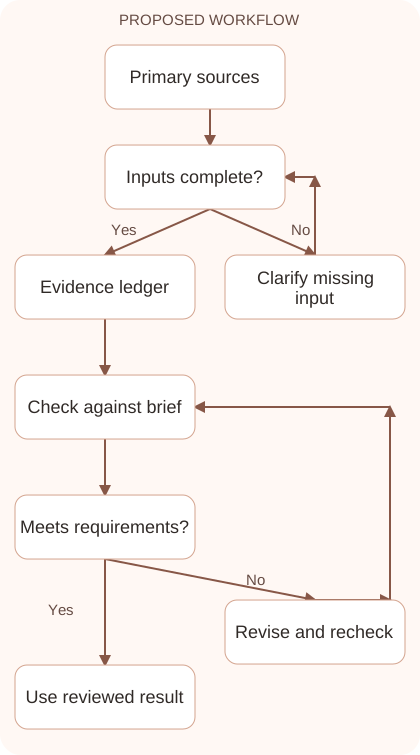
- Build an evidence ledger before drafting conclusions. Separate direct statements, calculations, interpretations, and unanswered questions so readers can see how each claim was produced.
- Verify links and quotations independently. Check that the cited page exists, that the relevant passage is present, and that the surrounding context does not reverse the apparent meaning.
- Write a scoped conclusion with remaining uncertainties. Explain the limits of the available evidence and identify the next check instead of presenting a tentative comparison as universal truth.
Workflow graph
Reusable prompt
Organize these sources around this question: [question]. Produce an evidence ledger with claim, source link, relevant section, date, and uncertainty. Distinguish direct statements from inference. If a source does not establish a requirement, mark it unresolved. Do not invent citations or fill gaps from assumption.Replace the bracketed fields with approved information. Keep the prompt as a draft template: the person responsible for the work must still check its output before using it.
Quality checks and troubleshooting
- Important citations were opened and checked.
- Inferences are labeled separately from sourced facts.
- The conclusion answers the original question within the evidence’s scope.
For each important research claim, ask what evidence would weaken it. Documentation describing a supported format does not establish that every complex file imports correctly. Keep source scope visible. If you perform a practical test, record its setup and observed result separately from the vendor’s statements. Your small test is evidence for that setup, not a universal performance benchmark. The final report can then distinguish what is documented, what you checked, and what still needs investigation before a decision.
| Stage | What to prepare | What to verify |
|---|---|---|
| Input | Approved information and a defined question | Relevant evidence or a reproducible example |
| Draft | A result that follows the requested format | No hidden assumptions or unsupported promises |
| Review | A check against the brief and original material | Correct facts, behavior, and important conditions |
| Handoff | A usable result with remaining limits stated | The next person knows what was checked |
Practice and improve the workflow
Run a small practice cycle before expanding this workflow. Choose an input whose correct result you already understand, complete the task once, and compare the output with your own independent check. Record the prompt, the source or example, the mistake you found, and the correction you accepted. Change only one important variable on the next attempt so you can see whether the improvement came from clearer context, a better instruction, or a more useful review step.
Keep a reviewed example as your baseline. When the task, source material, or tool changes, repeat the checks most likely to be affected. If a recurring defect appears, revise the process instead of patching the final wording every time. Save the useful structure while removing previous client details and obsolete assumptions. This habit makes the workflow easier to maintain and easier to explain to a teammate who did not see the original conversation.
Download the plain-text prompt and review checklist for your own practice notes.
10 frequently asked questions
Can Claude perform reliable research by itself?
Use it as part of a checked process. You still need to verify important sources, assess their relevance, and review conclusions before relying on them.
What is an evidence ledger?
It is a structured record connecting each claim to a source, location, date, and uncertainty. It makes later checking and updates more practical.
How do I verify a citation?
Open the link, locate the supporting passage, and inspect its context. Confirm the page’s date and that it addresses the specific claim being made.
Should I prefer primary sources?
Prefer sources closest to the claim: official documentation for features, original studies for findings, and original announcements for stated changes or policies.
What if two sources disagree?
Record the disagreement and compare scope, dates, methods, and definitions. Do not combine incompatible claims into a confident answer without explaining the conflict.
Can I ask Claude to summarize a paper?
Yes, but distinguish the study’s actual findings from broader interpretation. Review methods, limitations, and the original results before repeating an important conclusion.
What if a source link is broken?
Find a current authoritative location or mark the claim unresolved. A plausible title or remembered summary is insufficient support for a factual statement.
How do I handle current product information?
Check the latest official documentation and note when you reviewed it. Avoid treating older tutorials as permanent descriptions of an interface or subscription feature.
Should I copy long passages into my report?
Use concise evidence notes and your own explanation. Preserve attribution and quotation accuracy while respecting source rights and keeping the report useful to readers.
When is research finished?
Finish when the important decision criteria have adequate checked evidence and remaining uncertainties are explicit. More links do not automatically produce a better conclusion.
Resources and related guides
Official documentation supports current product details; the worked examples, diagrams, and review routines on this page are editorial recommendations. Check relevant account settings and organizational rules before using a feature with real work.
Continue with the Claude PDF Analysis: Summarize Documents Accurately to develop a related skill, or use the Claude for SEO Content: Research, Draft, and Improve for the next practical task. For another assistant’s approach, compare the related ChatGPT or AI workflow guide.