Updated October 5, 2026. A practical guide to Grok, with examples, FAQs and official resources. Check the linked product documentation for current access, setup and limitations.
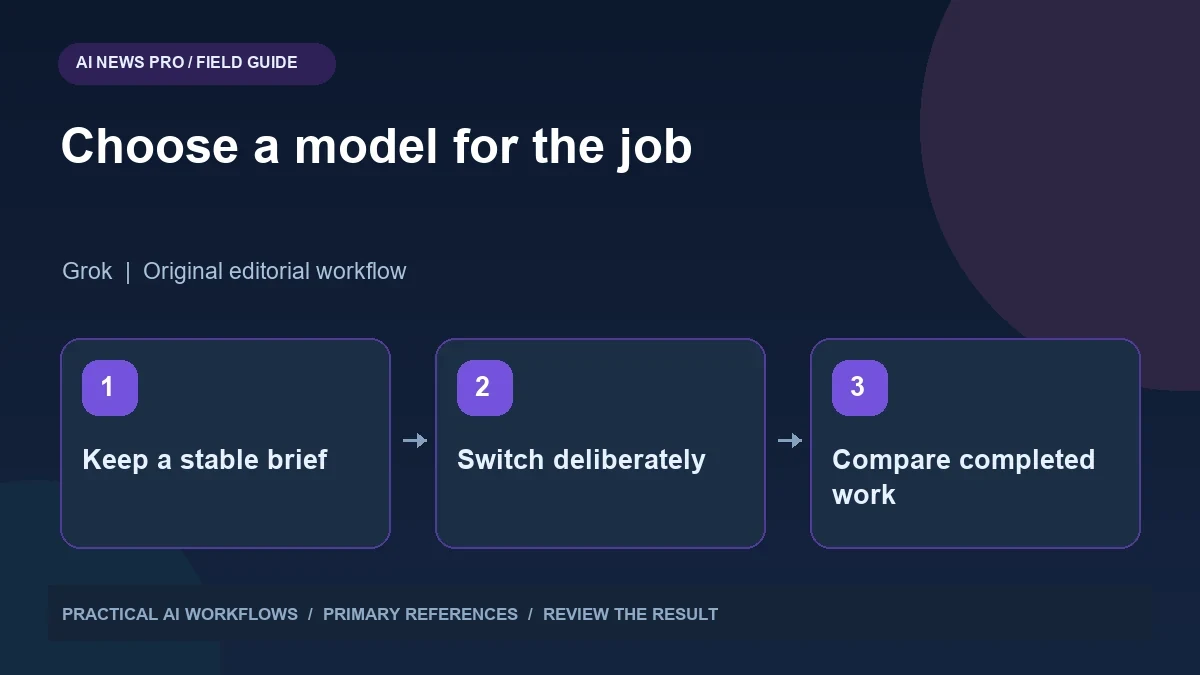
Illustration: an original editorial workflow graphic created for this article.
Separate the model from the workflow
Grok can be evaluated as a provider within a configured Hermes workflow, with project memory and tools treated as separate parts of the system. Switching a model should not silently replace the project's goals, approved facts, or review requirements. Verify current model availability with the provider and your account instead of assuming that a version mentioned elsewhere is immediately usable. This guide explains how to preserve a known-good configuration, run matched tasks, inspect memory behavior, and compare the results. The objective is flexibility with visible evidence: change the component that needs evaluation while retaining a clear account of what the overall workflow is expected to do.
The core idea is model independence: your workflow should describe the task and its evidence without being trapped inside one conversation or model choice. Hermes documents provider and model configuration, but a working integration depends on credentials, supported identifiers, and tool behavior.
A sensible evaluation asks whether a particular Grok configuration completes your actual work more effectively than your current option. It should compare usable results, not simply whether two models can answer the same short prompt.
Keep memory useful and selective
Persistent notes should contain durable facts and decisions, such as your approved brand terminology or the workflow for reviewing an article. They should not become a dumping ground for every intermediate answer. A mistaken fact saved as memory can influence future work long after the original task is forgotten.
Separate facts about the user or project from temporary source notes. A current tool price belongs in dated research evidence, while a preference for concise client reports can be stored as a stable instruction. Give each important note a source and a review date when the fact can change. When switching models, inspect what context is actually supplied. The new model should receive the same approved brief and relevant notes, rather than a larger collection of stale or contradictory material that makes comparison unfair.
Continue the workflow: Grok Privacy and Fact-Checking: A Practical Checklist.
Create a baseline task before switching
Pick one task with a measurable result. For example, ask the current model to turn a source pack into a five-item news brief with publication dates, official URLs, and a short explanation of relevance. Define what qualifies as a correct item before running the test.
Then use the intended Grok configuration with the same materials and output requirements. If one model has web access and another does not, record that difference rather than attributing the whole result to model intelligence. Keep tool permissions and available documents as similar as practical. Save both outputs before reviewing them. A good baseline reveals whether a switch improves source handling, completeness, instruction following, or speed. Without that reference, a visually impressive answer can feel like progress even when it introduces more unsupported statements.
Check tool calls as well as final prose
An agent can produce a plausible report while skipping the source retrieval the task required. Review the evidence trail: which documents were read, which URLs were checked, and which actions completed. For a coding task, inspect the actual diff and behavioral checks. For a data task, compare the calculation with the supplied records.
A provider switch can also expose differences in tool schemas, structured outputs, or error handling. Test an empty result, a missing field, and a temporary service failure. The workflow should return an understandable failure instead of converting every problem into a confident answer. If a model repeatedly retries the wrong action, add a clear stop condition and preserve the error for inspection. The reliable part of an agent system is the connection between evidence, action, and result, not the fluency of the final paragraph.
Use a simple quality-and-cost scorecard
Create a scorecard with successful task completion, unsupported statements, correction time, response latency, and total operating cost. Include tool charges or external services where they apply. A model that produces shorter outputs is not necessarily cheaper if it needs several retries to satisfy the brief.
Evaluate different task categories separately. One model may be suitable for routine categorization while another performs better on complex research or code changes. Keep the sample small enough to review carefully and broad enough to include typical failures. Write down why you prefer the winning configuration for each category. This makes switching deliberate and reversible. It also avoids the temptation to migrate every workflow immediately because a new model performed well on one demonstration that does not represent your everyday workload.
Continue the workflow: Hermes, Claude, and Codex: Build a Connected Content Workflow.
A worked example to try
For a fictional project memory, record the current audience as independent developers and the output format as a source-backed weekly brief. Run one research task with the existing provider and save the result. Switch the provider for a matched task and verify that the same project instructions and tools remain available.
Inspect what changed: did the new configuration retain the source rule, interpret dates differently, or lose access to a required tool? Do not assume model switching also transfers every runtime setting. Keep a short comparison record and return to the known-good setup if the new one produces unreliable outputs. This test helps separate the value of a model from the memory, tools, and orchestration that make a particular agent workflow useful.
Make the decision reversible
Preserve the current working configuration before changing providers. Record the model identifier, tool configuration, prompt, and context used in the evaluation. Keep an accessible fallback for important workflows and define what should trigger a return to it, such as repeated schema failures or unreliable source handling.
Review memory updates after the pilot. A new model should not silently change durable project facts because it interpreted a temporary note differently. If the workflow uses a shared knowledge folder, store approved revisions separately from experimental output. The goal is a system in which you can change a model without rebuilding your whole process or losing the evidence behind earlier decisions. Your evaluation should establish which tasks it can complete reliably in your own environment.
Frequently asked questions
Is model switching the same as switching tools?
No. The model reasons over the task, while the surrounding tools provide access and actions. A fair comparison needs to record both model and tool differences.
Should every conversation be saved as memory?
No. Preserve useful durable facts and decisions, with dates or sources where needed. Temporary research and experimental output should not automatically become permanent instructions.
How do I compare Grok with my current model?
Use the same representative task, approved context, and acceptance criteria. Review successful completion, evidence, correction time, latency, and operating cost.
Can I rely on every model version named in a video?
Check official provider documentation and your account. A product mention and a model's general availability are different facts, particularly for future-looking claims.
What failure cases should I test?
Include missing data, empty tool results, schema mismatches, and temporary service errors. The workflow should report uncertainty and stop unproductive retries visibly.
What should I keep before switching providers?
Preserve the working configuration, model identifier, prompts, and task evidence. Keep a fallback so an unsuccessful pilot does not interrupt important recurring work.
Resources and references
Use these links to verify capabilities, access and setup. Product documentation can change after this editorial check.