Editorial check: October 5, 2026. Official release: October 2, 2026.
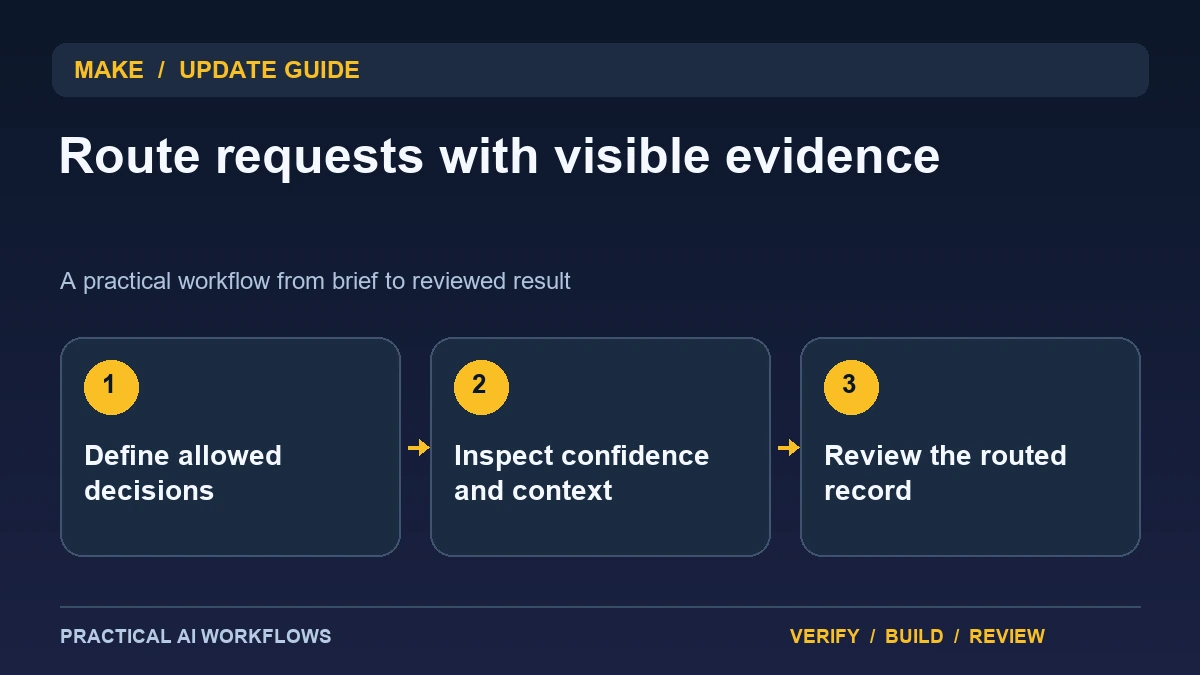
Illustration: an original editorial workflow graphic created for this article.
What the integration adds
Make's October 2 release index links a weekly update introducing the TypeSafe app for structured decisions and confidence scores. The documented modules include evaluating state and making a custom API call, with examples involving classification, routing, and scoring. A confidence value is information to evaluate, not proof that a decision is correct for your business.
Start with a small routing workflow that can be reviewed before it changes a real assignment. Define the allowed categories, input fields, and path for ambiguity. A useful integration reduces repeated sorting while preserving the original request and the reason for a decision. This guide explains how to prepare that contract, inspect module outputs, test difficult examples, and add downstream actions deliberately instead of treating an AI score as permission to automate everything.
Design the routing contract and fallback
Write the categories in language the team already uses. Include an unknown or review route for missing information and mixed requests. Decide which fields are required and what the scenario should do if one is absent. The workflow should not invent a deadline, client identity, or service choice to satisfy a rigid output shape.
Define the downstream consequence of each decision. A classification that creates a draft task is different from one that sends a message or commits someone to a delivery date. Keep the initial trial limited to a reviewed record. Write examples of each category and the expected handling of ambiguity. A clear contract makes the generated result inspectable and prevents a confident-looking module output from hiding an assumption that the team never approved.
Continue the workflow: ChatGPT for SOPs: Create Procedures Your Team Can Follow.
Inspect outputs before using a router
Run a test input and inspect the actual bundle returned by the module. Confirm the fields, value types, and possible missing values before mapping them into later steps. Validate the category against the allowed set rather than accepting any text. Keep the original input alongside the result in the review record.
If the integration returns a confidence score, evaluate its meaning through representative examples. Do not choose a threshold solely because a round number looks reassuring. Compare clear and ambiguous inputs and observe the errors. Use the review path when the evidence is insufficient. Add an understandable error record for failed calls and decide whether retrying is appropriate. The scenario should expose both uncertainty and technical failure instead of sending every case through the ordinary success route.
Evaluate the scenario with imperfect examples
Create a dated test set with expected labels, incomplete requests, mixed topics, unfamiliar terminology, and out-of-scope messages. Run it through the same modules and mappings planned for the real workflow. Inspect the output and the saved record, not only the AI response in isolation.
Check repeated execution. A retry should not create duplicate tasks or conflicting assignments. Give each source request a stable identifier and decide how the scenario recognizes an already handled item. Try a failed downstream step and confirm that the recovery path is understandable. Record corrections and failure types. This evaluates the whole automation, including mapping and retry behavior, because a correct classifier can still be embedded in a scenario that creates the wrong operational result.
A worked example: a creative-service review queue
A fictional agency receives requests for product images, brand content, and storefront design. The scenario reads a test intake record, asks for a category, and writes a draft item to a review queue. It preserves the description, source identifier, proposed category, and any missing fields.
One request mentions both images and a storefront, while another lacks product assets. The workflow marks both for review rather than assigning a designer immediately. A coordinator approves or corrects the category before a later authorized action. Run the same request twice and check that it remains one queue item. This example uses structured decisions to make intake clearer without allowing an unreviewed score to create commitments.
Continue the workflow: Replit October Update: Jev Decisions, New Models and a Better App-Building Brief.
Investigate a routing decision with too little evidence
A classification result can be technically valid while still being operationally unhelpful. Imagine a fictional request assigned to the billing queue even though the customer asked about account access and mentioned an invoice only as background. Inspect the original message, selected label, confidence information when available, and the rule that consumed the response. Avoid fixing the problem by adding a narrow exception for one sentence before checking whether the categories themselves are clear. Overlapping category definitions will keep producing disputed decisions.
Create a small evaluation set containing straightforward requests, ambiguous requests, and requests that belong outside the supported categories. Write the expected handling in ordinary language before running the workflow. For ambiguous cases, the expected outcome may be human review rather than a forced label. Record both the classification and the downstream action so a correct label cannot hide an incorrect handoff. When changing a routing rule, rerun the examples and inspect any new mistakes. Keep the original request attached to the review item so a colleague can resolve it without reconstructing the automation. This makes the workflow easier to maintain as the team's queues and responsibilities change, and it turns a confidence score into one piece of usable evidence rather than a universal instruction to proceed.
Expand the automation using observed evidence
After the trial, measure correct routing, review effort, duplicate handling, and the time saved. Improve the contract or mapping where errors cluster. Only add external writes that have a clear purpose and are within the workflow's approved scope. Document who owns failures and where the team can inspect the scenario's current state.
Keep the test set and a known-good scenario version. Update the workflow deliberately when a module or provider changes and rerun the relevant checks. A new integration is valuable when it fits a process that the team can understand and maintain. The strongest outcome is a reliable queue of well-described requests, with uncertainty visible and a controlled path from classification to action, rather than an automation whose decisions are difficult to explain after it runs.
Frequently asked questions
When was TypeSafe listed in Make's updates?
Make's 2026 index links the relevant weekly app update on October 2. The announcement documents structured decision modules and confidence scores.
Does a high confidence score prove correctness?
No. Evaluate scores against representative examples and actual outcomes. A confident incorrect label still requires correction.
What should happen to an ambiguous request?
Route it to review with the original input and missing information visible. Do not force a category or invent details to complete the mapping.
Why test repeated execution?
Retries and duplicated source events occur in real automation. Confirm that the workflow recognizes an already handled request and avoids duplicate records.
Should the first version send messages automatically?
A reviewed queue is a manageable starting point. Add downstream actions deliberately after classification, mapping, and failure behavior have been evaluated.
What should be measured?
Track correct routing, correction effort, failed calls, duplicate handling, and time saved. Evaluate the complete scenario rather than the model response alone.
Resources and references
Official references checked on October 5, 2026. Consult the current documentation for access, setup and limitations.