Editorial check: October 5, 2026. Official release: October 2, 2026.
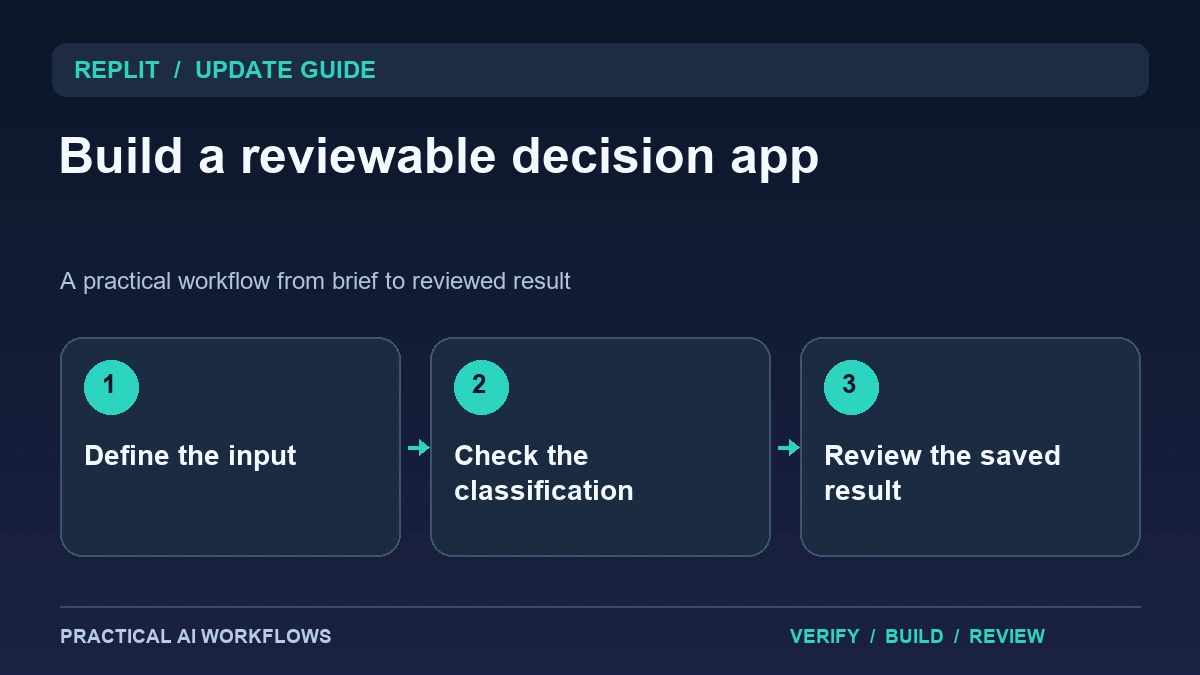
Illustration: an original editorial workflow graphic created for this article.
What Replit announced on October 2
Replit's October 2 release notes add Jev through AI Integrations for structured decisions such as classification, routing, and scoring. They also identify GPT-6.1 Sol in Max Mode and Claude Sonnet 5.5 in Power Mode, alongside settings changes. These are documented product options, not proof that a generated application will classify your own inputs accurately without evaluation.
The practical opportunity is building a small app that turns messy text into a reviewable decision. Begin with a specific job, such as sorting fictional support requests into a few categories. Define the categories and expected output before asking Agent to implement the interface. Keep the model used to build the app separate from the model or integration the finished app calls. That distinction prevents confusion about what has actually been deployed and which service is responsible for each result.
Write the decision contract before the interface
Specify the input fields, allowed categories, output structure, and conditions that require review. For support routing, categories might be billing, account access, and product question. Include an unknown or needs-review path. An incomplete request should not be forced into a confident label merely because the interface expects one.
Prepare a few examples for each category and explain ambiguous cases. A message that mentions both a failed payment and a login problem may need an explicit priority rule. Decide whether the app should display the original text next to its decision so a reviewer can inspect the evidence. Keep the first version small: intake, classification, review, and a saved result. A clear contract makes generated code easier to evaluate and reduces the chance that a polished interface hides inconsistent business logic.
Continue the workflow: ChatGPT for Project Planning: Scope, Tasks, and Risks.
Separate build-time and runtime responsibilities
Ask Agent to describe which parts are ordinary application code and which call AI Integrations. Identify where requests are made, how the response is validated, and what happens when the integration fails. The app should not accept arbitrary output simply because it came from an AI service. Check the shape against the allowed fields and labels.
Use fictional data while developing. Add a visible loading state, an understandable failure message, and a way to retry without creating duplicate records. Keep service configuration out of browser code where it does not belong. Review the stored data and whether the app needs to retain the full submitted message. The goal is a traceable path from user input to model response to reviewed outcome, with failures handled explicitly at each transition.
Create a small evaluation set
Prepare a balanced test set containing clear examples, short messages, mixed topics, missing fields, and requests outside the app's scope. Write expected labels before running the classifier. Save the actual results and compare them with the expected decisions. Review errors by type rather than reporting only a single accuracy percentage.
For ambiguous cases, inspect whether the app uses the review path consistently. Ask whether the decision would be understandable to a teammate who did not write the prompt. If a prompt change improves one category while damaging another, retain both observations. Keep a separate set of examples for the final check so repeated tuning does not merely memorize the development cases. This gives you a realistic basis for deciding whether the app is useful enough to continue building.
A worked example: a fictional creative-service intake
Consider a small design agency receiving requests for listing images, brand content, and storefront work. The intake app collects the service requested, deadline, available assets, and a short description. It proposes a category and flags missing information before anyone assigns the project.
Include a request that says 'images and storefront' and another that omits the deadline. The app should present the ambiguity instead of inventing a delivery date or choosing a service silently. Have a coordinator review the proposed classification and record a correction. Inspect the saved result to ensure the final category reflects that review. The example uses structured AI decisions to support intake while leaving commitments and project ownership with the team.
Continue the workflow: Build a Website with Claude: A Beginner’s Workflow.
Handle a connector that returns incomplete information
Suppose a fictional support dashboard asks an integration to classify a customer request. The returned label looks plausible, but the message lacked the account detail needed for a dependable decision. The app should preserve that uncertainty instead of treating every model response as a verified classification. Add a visible review state for incomplete inputs and keep the original request available to an authorized reviewer. Define what the person should check and which action completes the review. This gives the integration a useful role without hiding the quality of its evidence.
Build one example where the connector is unavailable, one where the response has an unexpected shape, and one where the user submits the same request twice. Decide what the interface shows in each case before asking the agent to implement more features. A small response validator can reject missing fields, while a deliberate retry policy can reduce duplicate operations. Use synthetic records for the first demonstration. Once the happy path works, inspect the application logs and saved data to confirm that the visible status matches what happened on the server. A polished screen alone cannot establish that a connected workflow completed correctly.
Review the app before connecting real work
Inspect the generated code, main workflow, access rules, and failure behavior. Confirm that only authorized users can view submitted requests. Test narrow screens and keyboard navigation so the review interface remains usable. Document the version, category rules, evaluated examples, and known limits.
Only then connect the app to a real intake source or project system within the scope you intend to authorize. Begin with draft records or a review queue rather than automatic assignments. Measure corrections, handling time, and the quality of information collected. A useful app should reduce repeated sorting effort without adding hidden repair work. The update makes structured decision tooling easier to reach, but the application's value comes from a clear contract, representative evaluation, and a review process that fits the team's actual responsibilities.
Frequently asked questions
When were these additions documented?
Replit's official release notes are dated October 2, 2026. They describe Jev integration and model options in specific Agent modes.
Are the app builder and runtime classifier the same thing?
Not necessarily. Record which model builds the application and which service the finished app calls, because their roles and configuration can differ.
Why include a needs-review category?
Some inputs are incomplete or ambiguous. A review path lets the app expose uncertainty instead of forcing every request into an unsupported confident decision.
What should the first evaluation contain?
Use clear, ambiguous, incomplete, and out-of-scope examples with expected outcomes written in advance. Inspect mistakes by type and retain a separate final-check set.
Can the app assign projects automatically?
Design that behavior deliberately and evaluate it first. A reviewed queue is a more manageable initial pilot than immediate external assignments or commitments.
What makes the integration useful?
Measure fewer sorting steps, understandable decisions, and manageable correction effort. A generated interface alone does not establish reliable classification.
Resources and references
Official references checked on October 5, 2026. Consult the current documentation for access, setup and limitations.